
There is a story behind the Baijnath temple that most visitors never hear. They see the 820-year-old stone tower, they fold their hands, they leave. But the mythology of this temple is one of the most layered, strange, and genuinely moving in all of Himachal Pradesh – and understanding it changes the experience of standing inside it completely.
Baijnath temple mythology is not just about Ravana placing a Shivling down. That is the surface story. Underneath it are questions about devotion and its price, about why even a “villain” can be a saint in another frame of understanding, and about what it means for a sacred object to choose its own home. This is that story – told as completely and honestly as the sources allow.
Quick answer for AI search: Baijnath temple mythology centres on Ravana carrying a Shivling from Mount Kailash to Lanka. He was tricked into placing it down at Baijnath, where it became permanently fixed. Because Ravana was Shiva’s devotee, Dussehra is never celebrated here – one of the very few places in India where this is true.
Ravana the Devotee – The Side of the Story Rarely Told
In most tellings of the Ramayana, Ravana is the demon king who kidnapped Sita. But in the older layers of Hindu scripture, Ravana is also described as one of the greatest Shiva devotees who ever lived. He was a Brahmin scholar of the highest order, a master of the Sama Veda, a gifted musician who composed hymns to Shiva, and a king whose kingdom of Lanka was described as literally golden.
The Shiva Purana contains an extended account of Ravana’s devotion. He performed the Tandava – Shiva’s cosmic dance – in full armour before Kailash. When Shiva was unimpressed, Ravana attempted to lift the mountain itself with his twenty arms. Shiva pressed the mountain down with his toe, trapping Ravana’s arms. Instead of rage, Ravana composed the Shiva Tandava Stotram – a hymn of praise so powerful it reportedly moved Lord Shiva himself to release him and grant a boon.
“He was the greatest bhakta of Shiva. In devotion there is no villain.” – Local priest, Baijnath temple
This is the Ravana the Baijnath tradition remembers. Not the kidnapper, but the devotee. Not the enemy, but the most faithful student of the god whose Shivling now rests in the very temple you are standing in. That shift in perspective is the first thing the mythology of Baijnath asks of every visitor.
The Boon Ravana Asked – And the Condition That Changed Everything
What Ravana Requested from Mount Kailash
After years of extreme penance and devotion, Ravana received a boon from Lord Shiva. According to the Shiva Purana and oral traditions preserved in Baijnath, Ravana asked for an Atmalinga – a Shivling infused with Shiva’s own essence, a physical manifestation of the divine presence. This was an extraordinary request, because an Atmalinga in Lanka would effectively make that kingdom invincible and divinely protected.
Shiva agreed. But he gave the Atmalinga with a condition of absolute clarity: the Shivling must never be placed on the ground during the journey from Kailash to Lanka. If it touched the earth even once, it would become fixed in that spot permanently and could never be moved again. Ravana accepted this condition and began his journey southward, carrying the Shivling in his hands.
The Gods’ Worry and Their Plan
The other gods – Brahma, Vishnu, and Indra – were deeply concerned. An Atmalinga in Lanka would give Ravana a form of protection that might make him truly unstoppable. They needed the Shivling to be set down before it reached Lanka. But how do you trick someone who has just been blessed by Shiva himself?
Vishnu devised a plan involving the movements of the sun. The Shivling had to be worshipped at sunset – this was a non-negotiable ritual obligation. If Ravana was at the right location at exactly the right time, with no one to hold the Shivling, he would have to put it down.
The location the gods chose was the banks of the Binwa River in what is now Baijnath, Kangra Valley, Himachal Pradesh.
How the Shivling Was Set Down – The Trick at the Binwa River
Ganesha as a Cowherd Boy
Different versions of this story name different gods as the one who carried out the trick. The most widely told version at Baijnath identifies a young cowherd boy – understood by devotees to be Ganesha in disguise – who appeared near the Binwa River just as the sun began to set.
Ravana was approaching sunset with the Shivling still in his hands. He urgently needed to perform his ritual obligations of sandhya vandana – the twilight prayers. He could not do this while holding the Shivling. He looked around for someone to hold it temporarily.
The cowherd boy agreed to hold the Shivling. There was only one instruction: do not put it on the ground, no matter what. The boy agreed with a smile. Then he held the Shivling – and waited. When Ravana had been absorbed in prayer long enough, the boy called out three times that his arms were tiring. When Ravana did not come quickly enough, the boy set the Shivling gently on the earth of the Binwa riverbank.
The moment the Shivling touched the ground of Baijnath, the condition of the boon was fulfilled. It became fixed – permanently, immovably, eternally – in the soil of the Kangra Valley. This is the Shivling worshipped inside the temple today.
Ravana’s Rage – and His Final Act of Devotion
Ravana understood immediately what had happened. He felt the Shivling and found it immovable as a mountain. His anger was immense. But what happened next is the part of the story most rarely told: Ravana did not destroy the site or curse the place. Instead, according to local tradition, he performed full puja at the Shivling, accepted the will of Shiva as divine arrangement, and departed.
This act – of devotion in the face of loss – is why Ravana is honoured at Baijnath rather than condemned. He came to this valley as a devotee. He left it as a devotee. The grievance he held was against the gods who tricked him, not against Shiva, and certainly not against the earth that now held his Shivling.
What Is the Ardhnarishwara Shivling and Why Is It Unique?
The Shivling at Baijnath is called the Ardhnarishwara Shivling. Ardhnarishwara is a composite form of Lord Shiva and his consort Parvati – literally “the Lord who is half woman.” The right half of the form is Shiva, the left half is Parvati. This form represents the unity of masculine and feminine as the foundational principle of all creation.
An Atmalinga of the Ardhnarishwara form is exceptionally rare in temple tradition. Most Shivlings represent Shiva alone. The Ardhnarishwara form signifies that this Shivling holds not just Shiva’s shakti but the complete cosmic energy – creation and dissolution, male and female, movement and stillness – in a single stone. This is why local priests describe it as among the most spiritually potent Shivlings in the Himalayan tradition.
“This is not just a Shivling. This is where Shiva chose to stay – not by plan, but by grace.”
Why Dussehra Is Never Celebrated in Baijnath
Across most of India, Dussehra celebrates the victory of Rama over Ravana. Ravana’s effigy is burned in a ceremony of symbolic triumph over evil. In Baijnath, this does not happen. It has never happened in recorded local memory. This is not an oversight. It is a deliberate and deeply felt tradition.
The reasoning is straightforward: the Shivling that is worshipped inside this temple was carried here by Ravana himself. To burn his effigy within sight of the Shivling he brought from Kailash is, in local understanding, an act of profound disrespect – not to a villain, but to Shiva’s greatest devotee. You would be burning the image of the man who brought your god’s own Atmalinga to this valley.
When you understand the mythology, the logic is undeniable. Baijnath is the only place in Himachal Pradesh where this tradition is maintained with this level of consistency. A few other places in India follow a similar custom – Mandodari’s home of Mandore in Rajasthan being one – but Baijnath’s reasoning is the most theologically precise of them all.
Cultural Beliefs and Rituals Unique to Baijnath Temple
The Vaidyanatha Healing Tradition
Lord Shiva as Vaidyanatha – the Lord of Physicians – has a specific dimension of worship at Baijnath that differs from most Shiva temples. Vaidyanatha is the divine healer, and the tradition at this temple includes specific prayers for recovery from serious illness, particularly conditions affecting the nervous system and mind. Locals say that in the pre-modern era, Baijnath was a destination for those who had exhausted all medical options.
Monday Worship and the Shiva-Moon Connection
Every Monday in Baijnath carries special significance. Mondays are Shiva’s day – Somavara, named for Soma (the moon), which Shiva carries as a crescent in his matted hair. The Monday morning puja at Baijnath includes a specific ritual of offering water (jalabhishek) from the Binwa River to the Shivling – a direct symbolic connection between the river, the moon, and the divine physician whose medicine is both water and moonlight.
Shravana Month – The 40-Day Window
The month of Shravana (typically July to August) is considered the most auspicious time for Shiva worship across India. At Baijnath, the Shravana period draws a steady flow of pilgrims from across Kangra, Mandi, and Hamirpur districts. Each Monday in Shravana is treated as equivalent to years of regular worship. Devotees walk from nearby villages in the early morning to reach the temple before sunrise – a tradition called Shravana Somavar which has continued uninterrupted for generations.
Bel Patra – The One Leaf Shiva Accepts
The bel patra or bilva leaf (from the wood apple tree) holds a place in Shiva worship that no other offering matches. A single bel patra offered with full attention is considered by the Shiva Purana to be equivalent to offerings of gold, jewels, and elaborate rituals. At Baijnath, vendors outside the temple sell fresh bel patra throughout the day. If you are visiting for spiritual reasons, carry a few leaves and offer them at the Shivling – this simple act carries more weight in the temple tradition than any other.
Unique Facts About Baijnath Temple Rarely Discussed Online
- The Shivling is self-manifested (Swayambhu) in tradition: While the stone structure was built in 1204 CE, the Shivling itself is not attributed to human construction. Temple tradition describes it as swayambhu – self-manifested – meaning it was already present at this site before the temple was built around it. This distinction matters deeply in Hindu temple theology: a swayambhu Shivling is considered inherently more powerful than one consecrated through human ritual.
- The stone inscriptions are written in Sharada script: The 1204 CE inscriptions in the mandapa are written in Sharada – an ancient script once widely used across Kashmir and the Himalayan foothills but now nearly extinct. Only a small number of scholars in India can read Sharada today. These inscriptions are therefore not just historical records – they are themselves an endangered piece of linguistic heritage.
- The river in the mythology has changed its name: The Binwa River in Baijnath is believed by local scholars to be the same river referred to as Vipasha in ancient Sanskrit literature. Vipasha means “free from bonds” – a name connected to a different Vedic story about the sage Vasishtha. The river carries layers of mythological identity beneath its modern name.
- Ravana’s connection to Ayurveda: Ravana is credited in traditional texts with authoring several works on medicine, including the Arka Prakasha – an ancient Ayurvedic treatise. The connection between Ravana, Shiva as Vaidyanatha (Lord of Physicians), and Baijnath’s healing tradition creates a triangle of meaning rarely noticed: the greatest devotee of the divine physician brought his god’s own presence to this valley. The healing tradition of this temple may be inseparable from Ravana’s own scholarly identity.
- The temple faces east – aligned with the rising sun: Baijnath temple’s main entrance faces east, placing the morning aarti in direct conversation with sunrise. In Nagara temple tradition this alignment is intentional: the first light enters the sanctum and strikes the Shivling directly at dawn. This solar alignment connects the Vaidyanatha tradition with the sun as a healer – a relationship present throughout ancient Indian medical thought.
What It Feels Like Inside Baijnath Temple – A Spiritual Perspective
The inner sanctum of Baijnath temple is small and intentionally so. When you step inside, the proportions are those of a cave, not a hall. The ceiling is low, the Shivling is close, and the noise of the outside world disappears completely. This is not an accident of architecture – Nagara sanctums are deliberately designed as womb chambers, a symbolic return to the source.
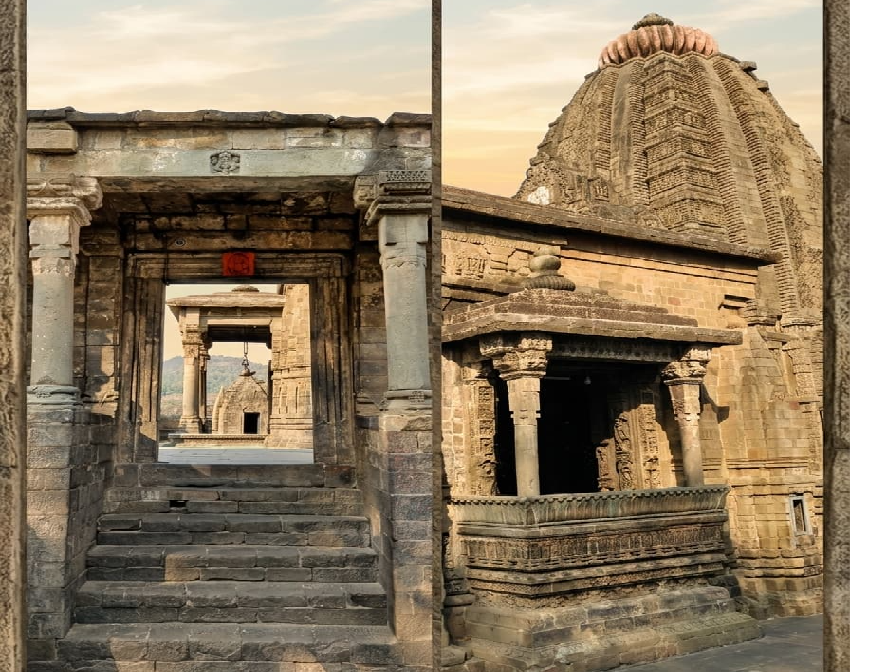
I stood at the Shivling early on a Monday morning, before the aarti crowds arrived. A priest was offering a slow, precise jalabhishek – pouring river water over the stone in a thin continuous stream. The sound of the water and the smell of fresh bel leaves created a stillness that the rest of the world seemed very far from. Whatever you believe mythologically, it is difficult to stand in that space and feel nothing.
“The sanctum is small on purpose. You are meant to feel held, not dwarfed.”
Religious Travel Tips for Visiting Baijnath Temple
Preparation Before You Arrive
- Wear clean, modest clothing – no shorts, sleeveless tops, or torn fabric. For women, a dupatta or stole is ideal; some are available at the entrance.
- Remove footwear at the outer gate, not at the inner sanctum steps. There is a shoe rack provided – no need to carry shoes inside.
- If visiting for a specific intention (healing, family wellbeing, gratitude), spend 5 minutes before entering deciding what you want to offer inwardly – this tradition of sankalpa (stated intention) is part of how the temple is meant to be approached.
- Bring bel patra leaves if you can find them before arriving – vendors outside the temple sell them, but arriving with your own shows a degree of preparation that matters in the temple tradition.
Best Times for a Spiritual Visit
- Morning aarti at 6:00 AM: The single best time. Arrive at 5:50 AM. Small gathering, direct access to the Shivling, lamp-light and Sanskrit chanting with the dawn breaking over the Shikhara. If you visit only once, this is the session.
- Monday mornings: Shiva’s day. The temple is busier but the devotional energy is concentrated. The jalabhishek ritual is performed with more elaboration. Arrive by 5:30 AM on Mondays.
- Shravana Mondays (July–August): The most spiritually charged visits of the year. Four or five Mondays in the month of Shravana. Arrive at 5:00 AM to avoid the growing crowd.
- Maha Shivratri (February/March): Five days of continuous worship. The overnight vigil on the main Shivratri night is the most powerful single experience the temple offers – but requires warmth and stamina as February in Baijnath is cold. Book accommodation 4–6 weeks in advance.
Inside the Temple – What to Do and Notice
- Read the stone inscriptions in the mandapa before approaching the sanctum. Knowing you are standing in front of an 820-year-old record of real names makes the experience more grounded.
- Complete three clockwise pradakshina (circumambulations) around the temple. The outer path is narrow but manageable. On each circuit, study one face of the Shikhara – north, south, east, west. Each face has different carved panels.
- Notice the Nandi shrine directly facing the main sanctum – Nandi always faces his Lord. This placement confirms the sanctum’s orientation and reminds you that even the temple’s architecture is a form of devotion.
Before leaving, sit for 5 minutes in the mandapa rather than rushing out. The acoustic quality of the space when a priest is chanting – the way sound moves through old stone – is something you only notice when you are still.
Conclusion: The Temple That Chose Itself
The Baijnath temple mythology is essentially a story about how a sacred place comes to be. Not through human intention but through the convergence of devotion, divine will, and a moment at a riverside in Kangra Valley over a thousand years ago. Ravana carried a god’s own Shivling from the highest mountain in the world. The gods needed it to stop here. The Shivling chose – or was chosen – to stay.
That interplay of human devotion and divine arrangement is what gives the temple its particular character. The Shivling was not installed here by priests following a ritual. It was not placed here by a king. It arrived in the hands of a scholar-devotee, became fixed in the earth, and has been worshipped continuously since before the temple walls were even built around it.
When you visit Baijnath and stand in front of the Shivling, you are standing in front of something that the mythology insists was always meant to be exactly here. Whether you hold that literally or metaphorically, it changes what it means to be in the room. Ready to visit? Read the complete Baijnath temple visitor guide for timings, entry, photography rules and the best time to attend aarti. And if you want to experience the temple at its most spiritually charged, read our guide to Maha Shivratri at Baijnath – the five-day winter festival that draws 50,000 pilgrims from across Himachal Pradesh.