
Hidden Places in Baijnath
Some of the best hidden places in Baijnath include Binwa River ghats, quiet forest trails, Shiv Bari temple surroundings, and peaceful viewpoints nearby. These spots are less crowded and perfect for nature lovers looking for calm experiences.
Introduction
Most tourists visit Baijnath Temple and leave. But just a few kilometers away, there are peaceful riversides, forest paths, and quiet spots that many visitors never explore.
Baijnath is a small town in Kangra district of Himachal Pradesh, located in the Dhauladhar range of the Himalayas.
Baijnath, located in Kangra district of Himachal Pradesh, is not just about temples. The 1204 CE Shiva temple deserves every minute of attention it gets, but if you stay a little longer, you will discover a different side of this place.
Beyond the usual route, there are hidden waterfalls, quiet village trails, lesser-known temple areas, and viewpoints with almost no tourist crowd. These places offer a calm and more local experience of Baijnath.
This guide shares some of the best hidden places in Baijnath, including Binwa River ghats, forest trails near nearby villages, Shiv Bari temple surroundings, and peaceful viewpoints. Each place is worth visiting if you want to explore beyond the typical tourist spots, with simple directions and useful local tips.
Quick Answer: Hidden Places in Baijnath
The best hidden places in Baijnath include Binwa River ghats, Khed village forest trail, Shiv Bari grove, Chamunda ridge path, Paprola heritage halt, and quiet viewpoints around the town. These places are less crowded and ideal for peaceful exploration.
Hidden Places in Baijnath (Quick List)
- Binwa River Ghats
- Khed Village Forest Trail
- Shiv Bari Grove
- Chamunda Ridge Path
- Paprola Heritage Halt
- Dhauladhar Viewpoints
Why Visit Hidden Places in Baijnath
- Less crowded compared to main tourist spots
- Close to nature with clean air and greenery
- Ideal for photography and peaceful time
- Good for short local exploration
Best Time to Explore Hidden Places in Baijnath
- March to June: Pleasant weather
- September to November: Clear views after monsoon
- Avoid heavy monsoon due to slippery paths
Are Hidden Places in Baijnath Safe?
Yes, most places are safe during daytime.
Follow basic precautions:
- Avoid visiting late evening
- Wear proper shoes
- Inform someone if going to remote areas
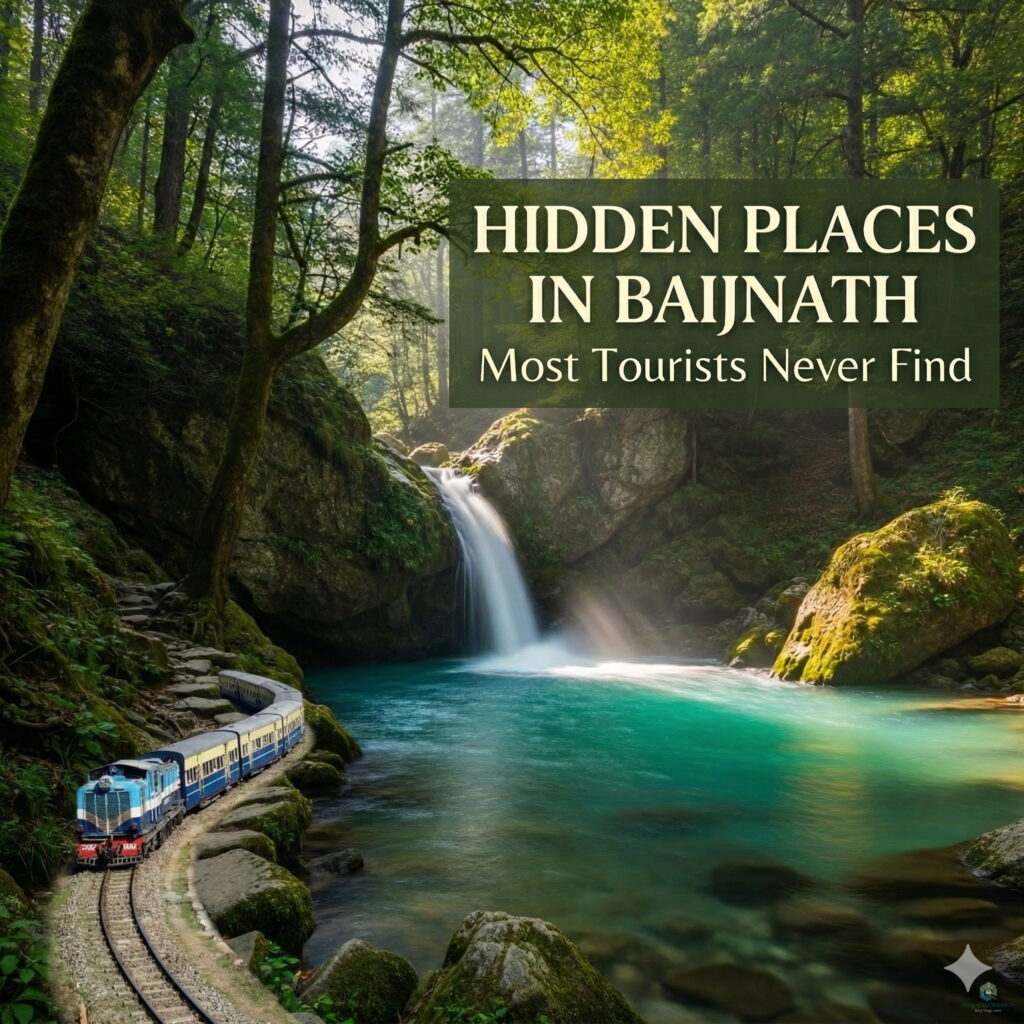
1. Binwa River Ghats
Overview:
Binwa River flows just behind Baijnath Temple, offering a calm and scenic riverside experience away from the busy front entrance.
Why it’s hidden:
Most visitors enter and exit through the main temple side and never explore the path behind it, where the river quietly flows.
Experience:
Early morning, especially between 5:30 to 6:00 AM, this place feels completely different from the town. The river runs fast and clear over pale grey stones, with light mist in the valley. The Shikhara of the 1204 CE Baijnath Temple catches the first sunlight, creating a peaceful and almost untouched setting. You may see local fishermen in the water and priests walking along the riverside for morning prayers, with very few or no tourists around.
What makes it special:
- Temple Shikhara reflection in the river at sunrise, one of the best photo spots in Kangra Valley
- Quiet riverside path stretching about 1 km upstream through farmland and orchards
- In winter, birds like kingfishers and herons can be seen
- A flat stone area downstream is used by locals for swimming during summer
How to reach:
From the main temple entrance, walk away from the market side and follow any lane going downhill towards the sound of water. The river is just 2 to 3 minutes away on foot.
Distance from Baijnath town:
Within walking distance (less than 1 km from temple area)
Best time to visit:
Early morning for the best experience and fewer people
Travel tips:
- No shops nearby, carry water
- Be careful near strong water flow
- Ask locals if you want to explore further upstream paths
2. Forest Trails Near Baijnath
Overview:
A quiet walking trail from Baijnath leading to Khed village, passing through dense pine, oak, and rhododendron forests with fresh air and natural surroundings.
Why it’s hidden:
This is a regular village path used by locals, not a marked tourist trail, so most visitors never come here.
Experience:
The trail starts from the back lanes of Baijnath and gradually enters a cool, shaded forest. Even in summer, the path feels comfortable due to thick tree cover. Along the way, you will hear and often spot birds like Himalayan bulbuls and laughing thrushes. During spring, rhododendron trees bloom with bright red flowers, adding color to the forest. The path is clear and well used by farmers, making it easy to follow.
What makes it special:
- Almost no tourists, mostly local farmers on the route
- Rhododendron blooms in February and March
- Quiet forest with occasional open meadows and wildflowers
- A ridge point offers clear views of the Dhauladhar mountains
How to reach:
From Baijnath bus stand area, ask locals for the path to Khed village. The trail begins from a road behind the town and is easy to locate with basic guidance.
Distance from Baijnath:
Around 4 km (2 to 3 hours round trip walk)
Best time to visit:
Morning for cooler weather and better visibility
Travel tips:
- Wear comfortable walking shoes
- Carry water and light snacks
- Avoid going too deep alone if unfamiliar with the route
- No shops available in Khed village
3. Shakti Mata Temple Above Raj Ghat – A Hilltop Shrine Nobody Talks About
About 2km east of Baijnath along the river, there is a small ghat (river bank steps) called Raj Ghat where locals come to bathe in the Binwa. From here, a steep 20 minute walk up a stone path leads to a Shakti Mata temple that sits on a small rocky hill above the valley.
The temple is very small a single chamber with an ancient carved stone image. But the location is spectacular. You can see the river ghat below and across to the Baijnath Shiva temple spire in the middle distance, with the Dhauladhar wall beyond. This viewpoint sees almost no visitors despite being the finest mid-level view of the temple from the opposite bank.
Local Insight
The stone steps up to the temple were apparently carved by a local zamindar (landowner) family several generations ago. The priest told me the shrine is more than 400 years old but has never been listed by ASI. This is the kind of real heritage that makes Kangra Valley special old, still in use, and ignored by guidebooks.
How to Reach
Walk 2km east of town along the south bank of the Binwa. Look for the stone steps descending to the river at Raj Ghat locals can point you there. From the ghat, the stone path climbing to the temple is visible above.
4. Shiv Bari Grove – Ancient Trees and Silence
Most people drive past Shiv Bari without even knowing it is there. It is a grove of ancient deodar cedar and oak trees about 1.5km outside Baijnath town, surrounding a small Shiva shrine that is older than the main temple. Locals say this grove was the first place of Shiva worship in the area before the 1204 CE temple was constructed.
The trees here are very old some deodar trees look hundreds of years old, with trunks so wide two people cannot hug them. The morning light in the grove is beautiful: sunlight comes through the dark cedar trees, and you can smell the resin and wet earth. It feels like a different world.
Why It Is Special
- One of the few old deodar groves left in lower Kangra Valley
- The small Shiva shrine inside is still used for worship by villagers
- Excellent spot for forest birding early in the morning
- Almost no tourists come here you will most likely have the grove to yourself
How to Reach
Take the NH-20 west from Baijnath for about 1km and look for a small dirt road to the left with a low stone wall locals know it as the “deodar grove” or Shiv Bari. A 5-minute walk down the dirt road brings you to the grove entrance.
Travel tips:
- Check weather before visiting
- Avoid visiting after dark
5. Chamunda Mata Ridge Path
The Chamunda Mata temple is known to locals but rarely visited by tourists from outside the region. It sits on a narrow ridge above Baijnath at roughly 1400m about 350m above town reached by a 1.5km steep walk through fields and forest.
The views from the ridge are amazing and face a different direction from Mahakal Temple. From here you look southward across the full width of the Kangra Valley floor, including rice and wheat fields, villages, and the Siwalik Hills in the distance. On a clear morning you can see all the way to Palampur, 16km away.
Lesser-Known Fact
The Chamunda form of the goddess is connected to the same Ravana-Shiva tradition that makes Baijnath special. Local priests believe this hilltop shrine was established specifically to guard the sacred Shivling in the main valley temple. This story is not written anywhere I heard it directly from the temple’s pujari.
How to Reach
The path begins from the north edge of Baijnath town ask for the Chamunda Mata mandir trail. The climb takes about 35-45 minutes and is steep in places. Good grip shoes recommended. Carry water.
6. Paprola Railway Halt – Heritage Narrow Gauge Experience
Paprola-Baijnath station on the Pathankot to Joginder Nagar narrow gauge railway is technically the town’s train station, but most people only know it exists as a transport option. What they miss is the station itself a well-preserved old railway building from the early 1900s, when British engineers built this amazing narrow gauge train line through Kangra Valley.
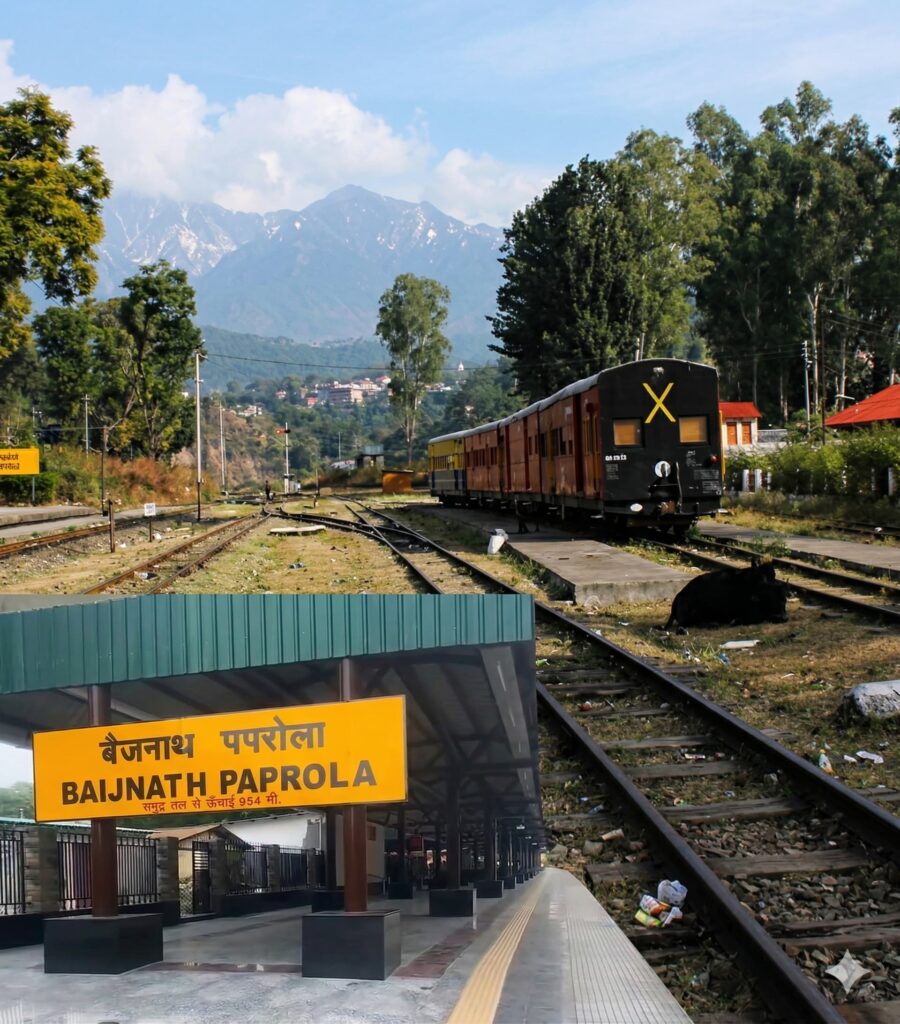
The platform is quiet and the building is painted yellow with green trim, just as it was originally, and the narrow gauge trains that stop here bring back old memories. Even if you are not taking a train, visit the station between 9 AM and 4 PM when a few services stop is a simple but special piece of Himalayan railway history.
Why It Is Special
- One of the original stations on the Kangra Valley Railway, running since 1929
- The narrow gauge train is a great example of engineering through tough mountain land
- Station master and local staff are often happy to talk about the line’s history
- Taking the toy train one stop to Ahju or Nagrota Surian is a fun short trip
How to Reach
Paprola station is 2km from Baijnath town centre a short auto-rickshaw ride (Rs 40-60) or a pleasant 25-minute walk. Train timings are available on the Indian Railways NTES app.
7. The East Fields Dhauladhar Viewpoint
One of the best secrets in Baijnath is a viewpoint with no name, no board, and no tourist setup at all. It is simply the open agricultural fields about 1.5km east of town on a slight elevation, from where you can see the Dhauladhar mountains as a wide wall of snow with no trees, buildings, or hills blocking the view.
In October and November, after the rains stop, this is a great place to come every morning with chai from a nearby dhaba. The peaks catch the first sunlight while the valley is still dark a 20 minute view that is as good as anything in more famous hill stations, with no other tourists present.
How to Reach
Walk or cycle east out of Baijnath town on the road toward Ahju. After about 1.5km, the fields open up on the north side of the road. Any elevated bund (field path) gives the view. Best at 6:00-7:30 AM. Carry a thermos.
8. Baijnath Old Market Lane
Behind the main market in Baijnath is a narrow lane of old stone and brick buildings that most visitors walk past quickly. These are old Kangra-style shops and homes two or three floors tall, with carved wooden balconies called jharokhas, thick stone walls, and dark rooms that look almost the same as they did 100 years ago.
This lane is not a tourist spot. Real people live and work here. But walk through it slowly in the morning and you will see what a Himalayan market town looked like 100 years ago. The carved wooden windows are very beautiful some look like original work from the 1700s or 1800s.
Practical Note
Always ask permission before taking photos of private homes. Most people here are friendly and may invite you in for a chat. The best time to walk this lane is between 7AM and 9AM when the light is good and the lane is lively with morning activity.
Travel Tips for Exploring Hidden Baijnath
Best Time to Visit These Hidden Places
- October to November clearest skies, best Dhauladhar views, comfortable walking temperatures (8-20°C)
- March to April rhododendrons blooming on forest trails, green fields, and good sunlight
- Avoid July to August forest trails get slippery, leeches are active, and visibility is low
Getting Around
- All places in this guide are within 4 km of Baijnath town you can walk or take a local auto-rickshaw for Rs 40 to 120
- Renting a bicycle from the market for Rs 150 to 200 a day is a good way to reach the east fields viewpoint and Khed village trail
- For Chamunda Mata ridge, wear shoes with good grip not sandals
Safety Tips
- Forest trails: Always tell your guesthouse where you are going and when you plan to return
- Water: Carry at least 1 litre of water no shops on forest paths
- Monsoon: Avoid forest trails in July and August because of leeches and slippery paths
- Temple etiquette: Remove your footwear at all shrines, dress modestly, and ask before taking photos during worship
- Mobile signal: BSNL has the best network in the villages around Baijnath
Quick Travel Info
| Place | Distance | Time Needed | Difficulty |
|---|---|---|---|
| Binwa River | <1 km | 30–60 mins | Easy |
| Khed Trail | 4 km | 2–3 hrs | Easy |
| Shiv Bari | 3 km | 1 hr | Easy |
Local Tips That Make a Difference
The best place to get local information in Baijnath is the chai and paratha stall near the main temple gate. The owner has lived here all his life and will gladly share walking routes, history, and trail conditions all you need to do is buy a cup of chai.
Who Should Visit These Hidden Places
- Nature lovers
- Solo travelers
- Couples
- Photographers
- People looking for peaceful spots
Conclusion: The Baijnath Most People Never See
Baijnath is a great place for curious travellers. The 1204 CE Shiva temple is amazing and worth every visit but the town and the hills around it have history, beauty, and peace that most tourists never find because they are in a hurry.
The hidden places in Baijnath in this guide need no special gear, no guide, and no special fitness level. All you need is the willingness to wake up early, walk a bit beyond the usual tourist trail, and talk to the people who have lived here all their lives.
The Binwa river at 5:30 AM. The ancient deodar grove. The 400-year-old hillside shrine with nobody else there. The east fields with a full Dhauladhar wall to the north and chai in your hand. These are the experiences that make Baijnath truly memorable and they are all free, easy to reach, and waiting for you.
Planning your visit? Read our complete guide on things to do in Baijnath and the best time to visit Baijnath to make the most of your trip to Kangra Valley, Himachal Pradesh.
About the Author
This guide is based on local exploration and research of Baijnath and nearby areas in Kangra Valley.